
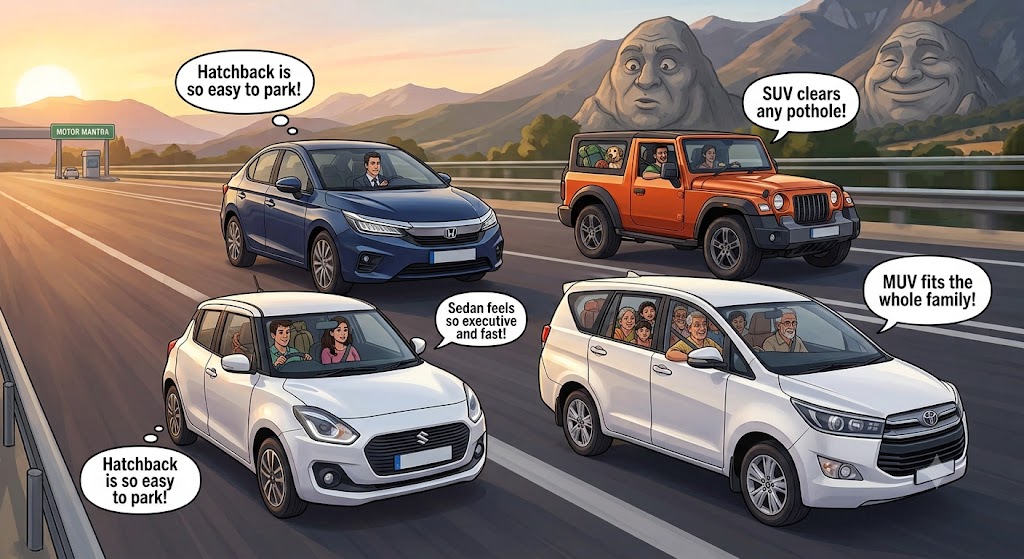
Types of Cars in India Explained: How to Choose the Perfect Body Style for Your Needs
Table of Contents
Walking into a car showroom can feel completely overwhelming. Salespeople love to throw around complicated marketing terms like “Compact Crossover,” “Premium Hatchback,” or “Monocoque SUV.”
If you don’t know what these terms mean for your daily drive, you might end up buying a vehicle that doesn’t fit your lifestyle, family size, or parking space.
At MotorMantra.in, we believe in skipping the showroom sales pitch. In this foundational guide, we are going to break down the four main car body types in India using simple, real-world logic so you can choose the absolute best style for your daily commutes and weekend trips.
1. The Hatchback: Your Urban Companion
A hatchback is a compact car where the passenger cabin and the boot (luggage area) are built as one single, continuous space. Instead of a separate trunk lid, the entire rear window lifts upward like a hatch to give you access to your bags.
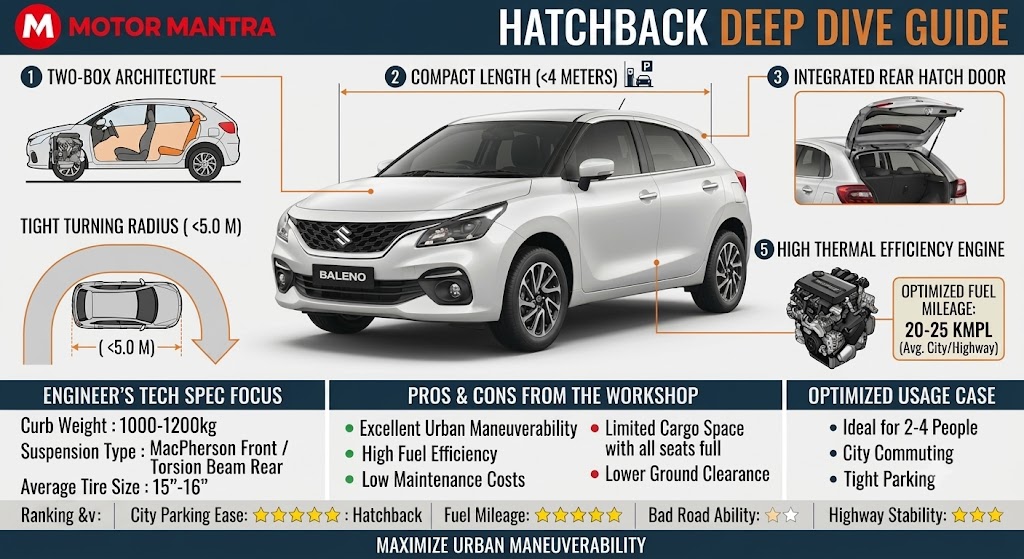
- Best Suited For: First-time buyers, small families (2 to 4 people), and heavy city commuters who deal with tight parking spaces and bumper-to-bumper traffic.
- The Pros: Exceptional fuel mileage, effortless to park, and usually the most affordable cars to buy and maintain.
- The Cons: Limited luggage capacity when all seats are full; lower ground clearance means you have to be careful over giant city speed breakers.
- Popular Examples in India: Maruti Suzuki WagonR, Swift, Baleno, Tata Altroz, and Hyundai i20.
💡 MotorMantra’s Insight
Because there is no extended trunk hanging off the back, hatchbacks have a very short footprint. A shorter frame means the car is naturally lightweight, agile, and has a incredibly tight turning radius, making it perfect for slicing through chaotic city lanes.
2. The Sedan: The Elegant Highway Cruiser
A sedan is a traditional, low-slung car with a “three-box” design. This means the car is clearly split into three separate sections: the engine bay in the front, the passenger seating area in the middle, and a completely separate, lockable, closed boot at the back.
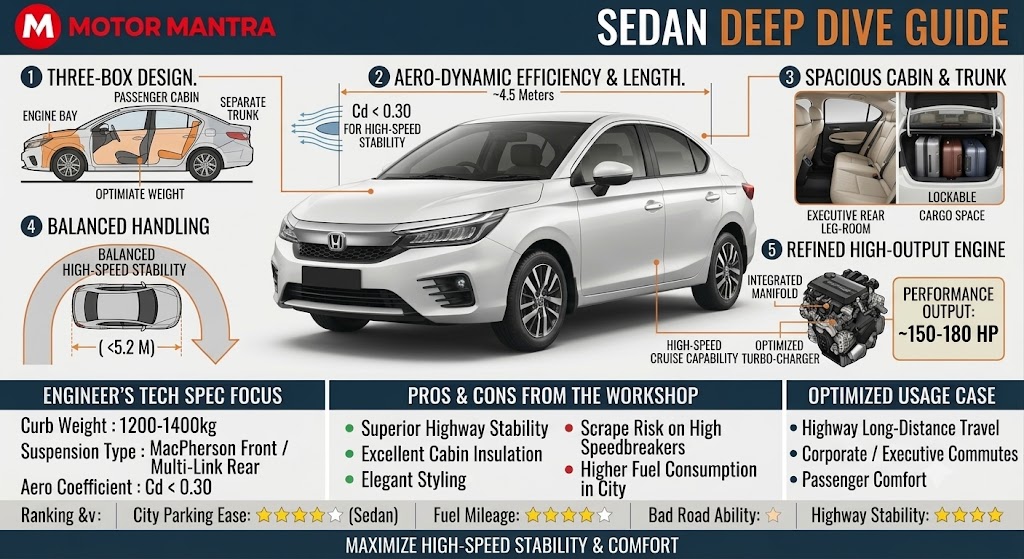
- Best Suited For: Drivers who love smooth highway road trips, executive styling, and back-seat passenger comfort.
- The Pros: Best-in-class high-speed stability, superior cabin insulation (less road noise), and a secure trunk that keeps your luggage completely hidden out of sight.
- The Cons: Low ground clearance means the underbelly can easily scrape against deep potholes or steep parking ramps when fully loaded.
- Popular Examples in India: Maruti Suzuki Dzire, Honda City, Hyundai Verna, Volkswagen Virtus.
💡 Our Workshop Take
Sedans sit very close to the ground, which naturally prevents that tilting, top-heavy feeling you get when taking a sharp turn in taller vehicles. On open highways, they cut through the wind smoothly with very little resistance, giving you a highly planted and confident ride.
3. The SUV (Sport Utility Vehicle): The All-Terrain Dominator
SUVs are high-riding vehicles built with tall frames, muscular body designs, large wheels, and elevated seating positions. In India, these range from small “micro-SUVs” up to giant, heavy off-roaders.
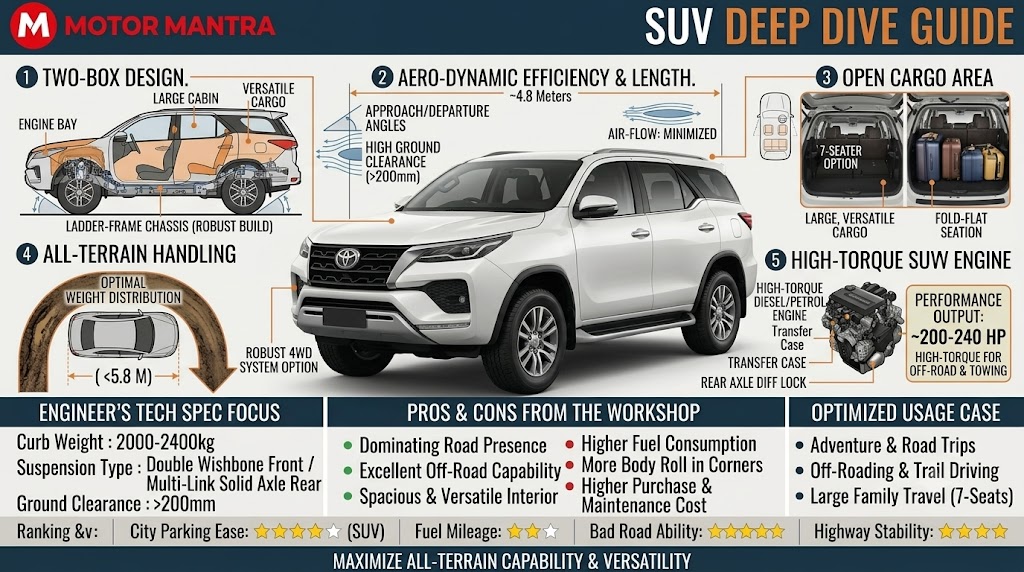
- Best Suited For: Families living in areas with bad roads, weekend travelers, and drivers who want a commanding, tall view of the traffic ahead.
- The Pros: Easily clears massive potholes, handles water-logged streets well, commands immense road presence, and offers easy ingress and egress (getting in and out without bending down).
- The Cons: Due to the tall design, they tilt a bit more in sharp corners and consume more fuel than lower hatchbacks or sedans.
- Popular Examples in India: Tata Punch, Maruti Suzuki Brezza, Hyundai Creta, Mahindra Thar, Scorpio-N.
💡 Our Insight
Modern SUVs use specialized, flexible suspension setups with high ground clearance. This design allows the wheels to move up and down significantly to absorb massive impacts, keeping vital parts under the car safe from broken tarmac or hidden rocks.
4. The MUV / MPV (Multi-Utility / Purpose Vehicle): The People Carrier
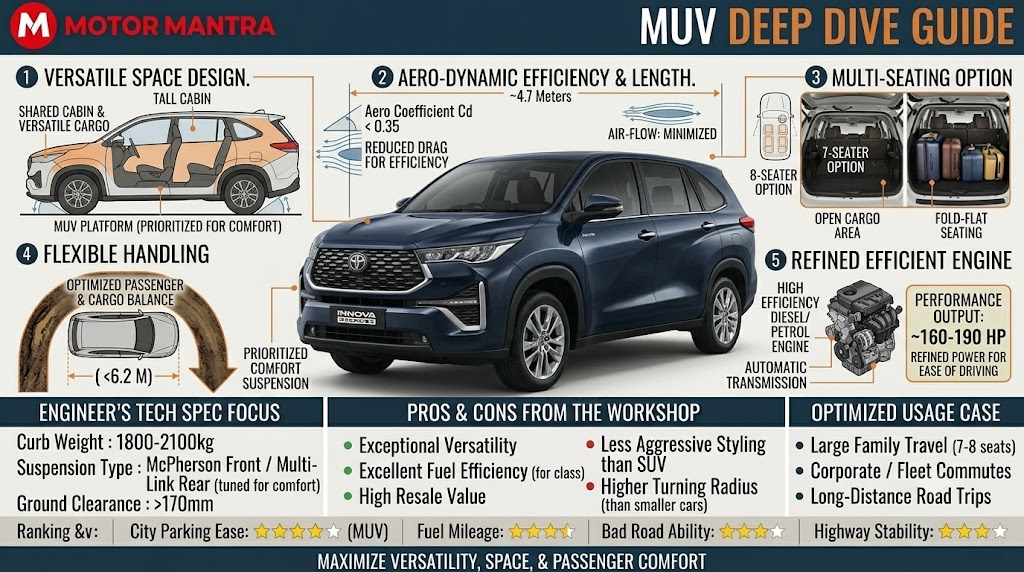
MUVs are vehicles built with a “maximum space” philosophy. They are specifically shaped like a box to optimize internal real estate, offering three rows of seating to carry 6 to 8 people comfortably.
- Best Suited For: Large joint families, tour operators, and long-distance group road trips.
- The Pros: Can transport 7 adults comfortably with dedicated AC vents for all rows, and offers incredible practical value per seat.
- The Cons: Boxy, van-like styling can look plain; their large size makes them more difficult to maneuver and park in tight residential lanes.
- Popular Examples in India: Maruti Suzuki Ertiga, Kia Carens, Toyota Innova Crysta / Hycross.
💡 MotorMantra’s Insight
While SUVs prioritize rugged style, MUVs focus entirely on cabin volume and ride smoothness. The shock absorbers on an MUV are tuned softly to ensure that passengers sitting in the very last row don’t feel bouncy or uncomfortable over long journeys.
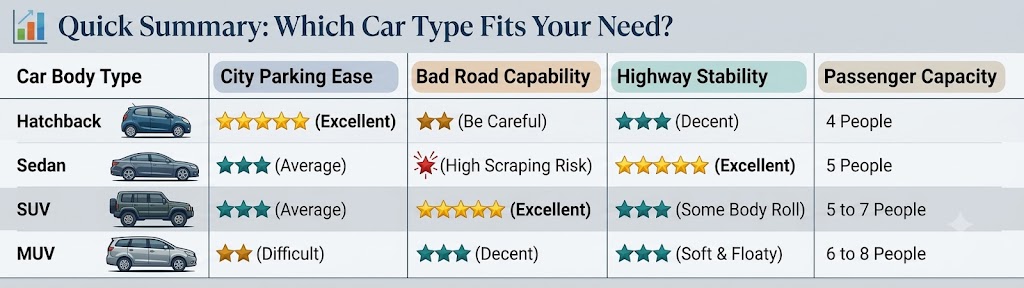
📊 Quick Summary: Which Car Type Fits Your Need?
Frequently Asked Questions ( FAQ)
Hatchback vs sedan vs suv: which is best for a first-time buyer?
For most first-time buyers in India, a Hatchback is the best choice. It is affordable, highly fuel-efficient, and easy to park in tight spaces. However, if you regularly travel with a family of 5 or face terrible road conditions daily, a compact SUV might serve you better.
What is the exact difference between suv and muv cars?
It comes down to styling and purpose. SUVs focus on rugged design, high ground clearance, and all-terrain capability. MUVs prioritize internal cabin space, flexible three-row seating, and maximum passenger comfort for large groups.
What are some of the most fuel-efficient sedan cars in india?
Compact sedans like the Maruti Suzuki Dzire lead the segment with fuel efficiency figures often crossing 22 to 25 km/l (especially in smart-hybrid or CNG variants). Premium sedans like the Honda City and Volkswagen Virtus also offer a balanced 16 to 20 km/l on highways.
What does compact suv meaning imply for ground clearance?
A compact SUV is a vehicle engineered to look and feel like a rugged SUV but kept under 4 meters in length to save on taxes. Despite their small footprint, they offer an excellent ground clearance of 180mm to 205mm, allowing them to clear large obstacles effortlessly.
Which car body style handles water-logged city streets best during monsoons?
An SUV is the most reliable option during heavy monsoons. Its high ground clearance keeps the exhaust pipe and critical engine components well above the water line compared to low-slung sedans or smaller hatchbacks.
Still Confused About Which Car Type Fits Your Budget?
Don’t worry! Now that you know the structural differences between these models, we can help you find the exact vehicle model that gives you the best value for your money.
Head over to our [Contact Us Portal] to drop your daily driving requirements, and our team will personally help you decode your next car purchase.