
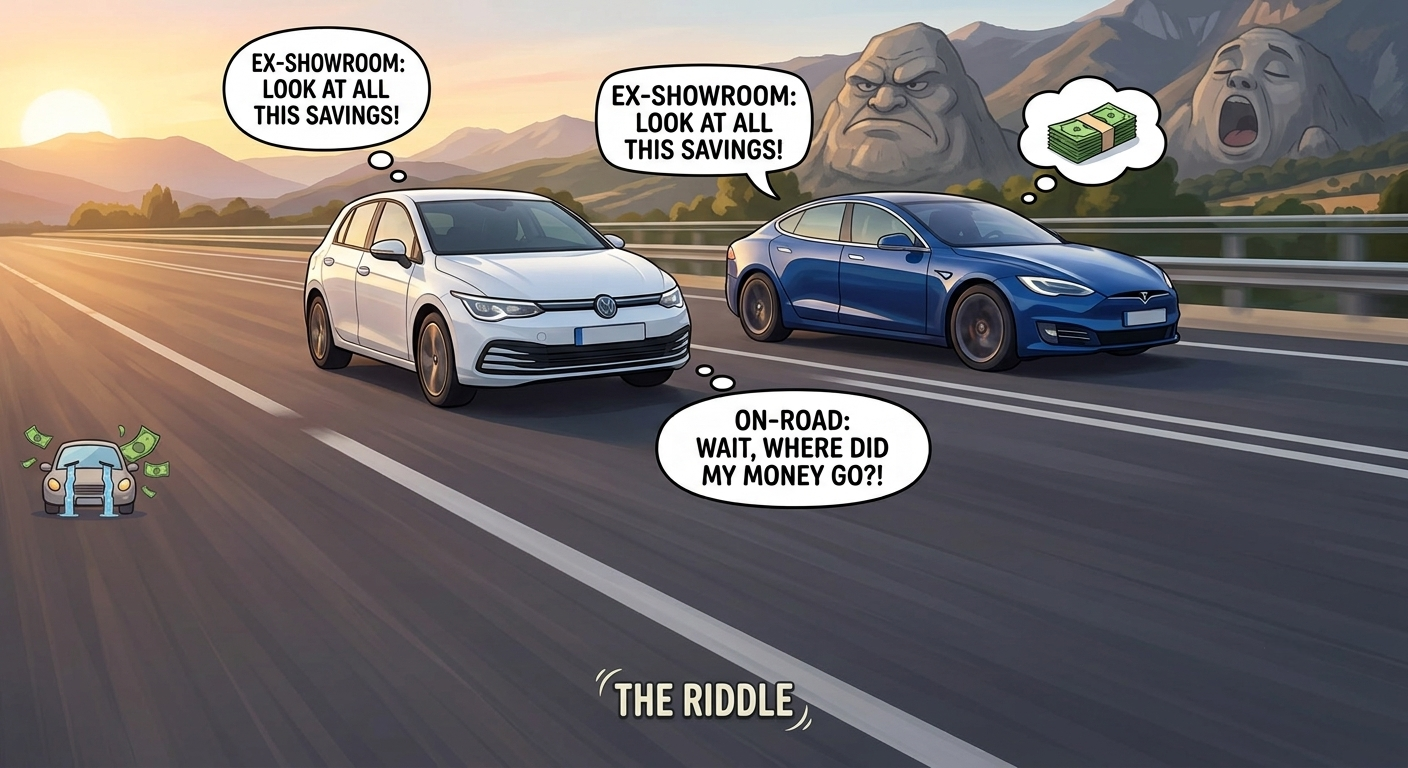
Ex-Showroom vs On-Road Price Explained: The Hidden Costs of Buying a Car in India
Table of Contents
You’ve spent weeks researching your dream car. You finally see a print advertisement or a website listing that says the car costs ₹7,99,000. Excitedly, you walk into dealership with your checkbook, only for the salesperson to hand you a final quotation sheet that reads ₹9,45,000.
Your jaw drops. Where did that extra ₹1.5 Lakh come from?
The biggest trap for new car buyers in India is budgeting based on the Ex-Showroom Price instead of the actual On-Road Price. At MotorMantra.in, we don’t want you to face any surprise shocks on delivery day. In this guide, we will break down exactly what these numbers mean, reveal the hidden fees dealerships sneak onto your bill, and show you exactly what you can legally negotiate to save thousands.
What is the Ex-Showroom Price?
Simply put, the Ex-Showroom Price is the base cost of the vehicle set by the manufacturer. It includes the cost of manufacturing the car, the company’s profit margin, transport costs to the dealership, and the national Goods and Services Tax (GST) along with compensation cess.
Think of it as the price of the car before it is legally allowed to drive out of the showroom doors. You cannot legally drive an ex-showroom car on public roads because it doesn’t have a registration plate, road tax clearance, or insurance.
What is the On-Road Price?
The On-Road Price is the final, all-inclusive amount you pay to legally drive the car out of the dealership and onto public roads. This number can vary drastically from state to state—and even city to city—because it includes localized taxes and legal necessities.
Here is the breakdown of what bridges the gap between the sticker price and your final check:
1. RTO Registration Charges & Road Tax (Mandatory)
This is a direct tax paid to your state government for using the public road infrastructure. Depending on where you live in India, road tax typically ranges from 8% to 15% of the ex-showroom price.
- States like Karnataka and Maharashtra have higher road tax slabs.
- States like Goa or Union Territories like Delhi/Delhi-NCR generally charge less.
- Fuel Type Matters: Many states offer massive discounts or 0% road tax on Electric Vehicles (EVs) or strong hybrids, while diesel vehicles often face the highest tax penalties.
2. Car Insurance (Mandatory)
By Indian law, you must have at least a 3-year third-party insurance cover before your car touches a public road. Showrooms will bundle a 1-Year Own Damage + 3-Year Third Party comprehensive policy into your quote.
3. TCS (Tax Collected at Source – Mandatory)
If the ex-showroom price of your vehicle is above ₹10 Lakh, the government mandates a 1% TCS fee. This is an advance income tax collected by the dealer, which you can later claim back when filing your annual ITR.
⚠️ The Showroom “Add-Ons”: What is Hidden vs. Optional?
This is where dealerships make their extra margins. When you look at your quote sheet, keep an eye out for these line items:
- Handling Charges / Logistics Fees (ILLEGAL): If you see a charge labeled “Handling Charges” or “Depot Fees” ranging from ₹5,000 to ₹10,000, refuse to pay it. The Supreme Court of India has ruled these charges illegal, as freight and transit costs are already included in the ex-showroom price.
- Essential Accessories Kit (OPTIONAL): Dealers love to add a pre-packaged bundle of floor mats, mud flaps, and chrome garnishes costing anywhere from ₹8,000 to ₹25,000. You are under no legal obligation to buy this from them. You can buy higher-quality accessories online or from aftermarket shops for half the price.
- Extended Warranty (RECOMMENDED): This covers mechanical failures after the standard factory warranty expires. While optional, our workshop team highly recommends opt-ing for this to safeguard against expensive modern electronics or sensor failures down the line.
📊 Summary: The Price Gap at a Glance
To help you budget ahead of your showroom visit, here is a realistic estimate of how much the price inflates based on a standard petrol car in a mid-tier tax state:
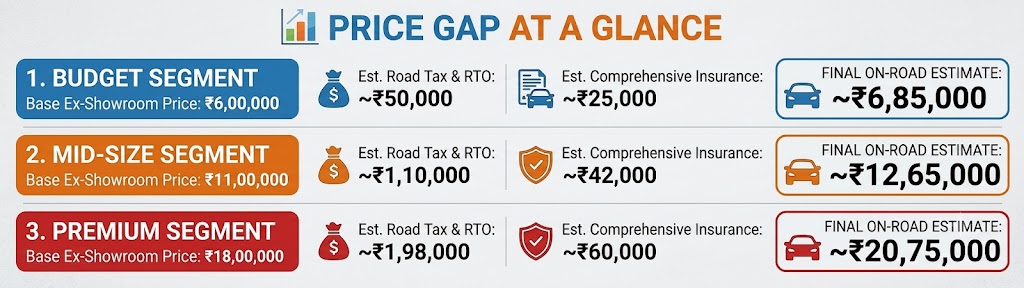
*Note: Prices above 10L include 1% TCS. Final local quotes will vary slightly based on state tax percentages.
Frequently Asked Questions ( FAQ)
Why is the on-road price of the exact same car different in Delhi and Bangalore?
Road tax is a state-level subject in India. Each state government calculates its road tax percentage differently based on the vehicle’s engine size, fuel type (Petrol/Diesel/EV), and whether it is registered under an individual or a corporate name.
Can I buy car insurance from outside instead of the dealership?
Yes, absolutely! Dealerships often inflate insurance premiums by 30% to 40%. You have the legal right to source your own comprehensive insurance quote from external providers. Show the lower outside quote to your dealer—they will almost always match it to keep your business.
What is the rule of thumb for calculating on-road price?
Private vehicle registration and road tax in India are paid upfront for a period of 15 years. After 15 years, you must visit the RTO to renew your vehicle’s fitness certificate and pay a nominal re-registration fee.
Got a Dealer Quote That Looks Suspect?
Don’t let sneaky showroom fees inflate your car loan. Paste the line-by-line breakup of your quotation in our [Contact Us Portal], and our workshop team will happily audit it to tell you exactly where you are being overcharged!